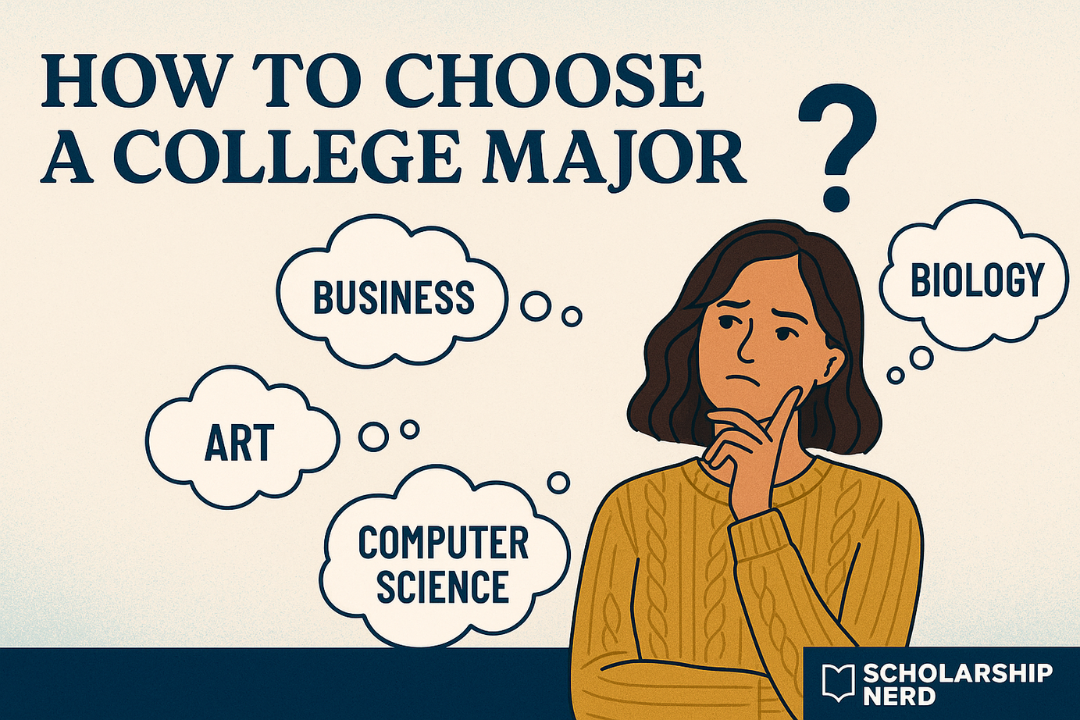

If you’re stressing about what to major in, take a deep breath. You’re in good company. According to the U.S. Department of Education, roughly one in three students changes majors during college. That’s proof that it’s completely normal not to have it all figured out yet.
Maybe you’re torn between two subjects you love. Or maybe you don’t feel a strong pull toward anything yet. That’s okay. Choosing a college major isn’t about having your entire life mapped out; it’s about learning who you are and discovering how your interests, strengths, and values align with possible paths.
In this guide, I’ll share the same steps I’ve used to help hundreds of students move from uncertain to confident in their major choice, plus a few insider tips from my years as a college admissions counselor.
1. Start With Your Interests and Strengths
Before you start comparing majors, start by asking: What actually excites me?
The biggest mistake I see students make is picking a major because someone told them it’s “safe” or “practical.” The truth is, you’re far more likely to succeed in a field that genuinely interests you.
Take some time to reflect on:
- What school subjects come naturally to you?
- What projects or activities make you lose track of time?
- What kinds of problems do you enjoy solving: creative, analytical, social, or technical?
You can also try a career assessment tool like the Holland Code or O*NET Interest Profiler to see which majors align with your personality and skills. These tools don’t tell you “the answer,” but they’ll spark ideas and connections you may not have considered.
Your major should feel like an extension of what already interests you, not a label you force yourself into.
Pro Tip: Look for ways in which your interests and passions intersect. For example, if you love math but also have a creative side, explore data analytics or architecture, fields that blend numbers and imagination.
2. Research Career Paths and Job Outlook
Once you’ve narrowed down your interests, it’s time to connect them to the real world.
A great starting point is the U.S. Bureau of Labor Statistics’ Occupational Outlook Handbook. It breaks down thousands of careers with data on:
- Median salaries and projected job growth
- Typical education paths
- Work environments and responsibilities
Cross-reference this with O*NET Online, which helps you explore job titles by skill sets and interest areas. You’ll start to notice patterns; for example, communication majors often go into public relations, marketing, or education, while psychology majors may branch into counseling, HR, or research.
A smart major choice is one that fits your interests and has healthy career prospects.
Pro Tip: Don’t pick a major only for the paycheck, but don’t ignore financial stability either. Look for a balance between fulfillment and opportunity.
3. Consider Your Values and Lifestyle Goals
Your major doesn’t just affect your future job; it can shape your day-to-day life.
Ask yourself:
- Do I want a predictable routine or flexible schedule?
- Do I thrive on collaboration or prefer independent work?
- What kind of impact do I want to make?
If you’re motivated by helping others, majors like nursing, social work, or education might fulfill you more than high-paying fields. If you love creating, you might prioritize flexibility and self-expression through design, writing, or the arts.
Pro Tip: Always think about the life you imagine for yourself, not just the job title. Do you picture yourself traveling? Working remotely? Leading teams? Your answers can help shape the major that fits.
Example context:
Choose a major that aligns with the kind of life you want to build, not just the classes you’ll take.
4. Talk to Advisors, Mentors, and Alumni
One of the most valuable and underused resources on campus is conversation.
Talk with:
- Academic advisors who can explain program requirements and how to switch majors efficiently
- Career counselors who can connect you with internships or personality assessments
- Professors and alumni who can share what real work in that field looks like
You can also join student clubs, attend career fairs, or shadow professionals for a day. These experiences give you real-world context that no course catalog can match.
Guidance from real people helps you see the difference between what sounds interesting and what feels right.
5. Try Courses Before You Commit
Here’s something every undecided student should know: you don’t have to choose right away.
Your first year or two of college is designed for exploration. Most schools require general education classes, which means you can try different fields while still earning credits toward graduation.
Consider taking an introductory class in psychology, coding, art, or economics. You’ll quickly learn what sparks your curiosity and what doesn’t.
If you do change your major, you’re far from alone. Research from the National Center for Education Statistics shows that about 30 percent of students switch majors at least once.
Remember: Exploration is progress, not procrastination.
6. Keep Perspective: Your Major Isn’t Your Forever Path
Your major is a starting point, not a life sentence.
Plenty of people build successful careers in areas unrelated to their degree. English majors work in tech marketing, art majors become UX designers, and biology majors go into finance. What matters most is the skills you gain such as critical thinking, communication, and problem-solving, not just the label on your diploma.
When I worked in admissions, I saw graduates with the same major go in completely different directions, and all of them found success. The key was learning how to think, not what to memorize.
According to the Bureau of Labor Statistics, most workers change careers multiple times over their lifetime. So instead of chasing the “perfect” major, focus on building adaptable skills and experiences that can grow with you.
You can change your mind and your path in life as you learn more about yourself.
FAQ: Common Questions About Choosing a Major
What if I regret my major?
You can always change or add a minor. Many students do. Talk to your advisor about course overlap so you don’t lose progress toward your degree.
Should I choose a major based on salary?
Salary is important, but it shouldn’t be the only factor. Use the BLS and College Board’s BigFuture to compare earning potential, then weigh it against your interests and values.
How many times can I change my major?
There’s no strict limit, but changing too late can extend your time and tuition. That’s why early exploration is key.
What are the most flexible majors?
Majors like communications, business, and psychology open doors across industries, making them ideal if you’re still discovering your path.
Can I get a job outside my major?
Absolutely. Employers care most about your skills and experience, not the specific title of your degree.
Take the Next Step Toward Your Future
Choosing a major doesn’t have to be scary. It’s a process of discovery, and you don’t have to do it alone. Whether you’re still exploring or ready to decide, you can take control of your education and your financial future today.