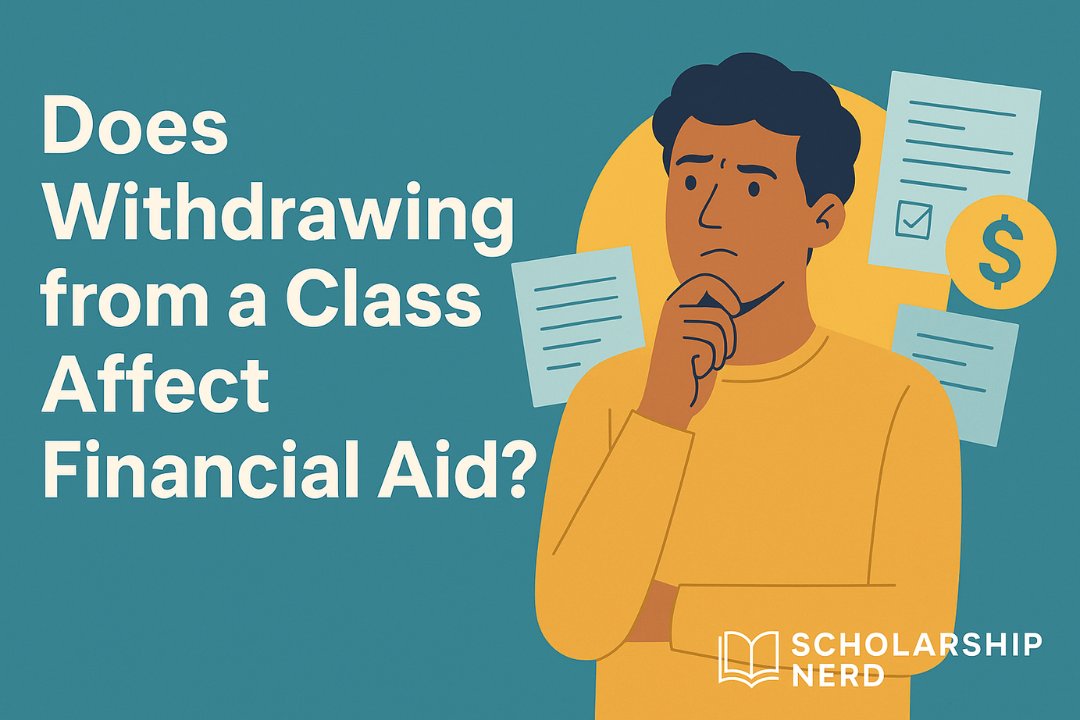

If you are staring at your schedule wondering, “Should I drop this class.” you are not alone. And yes, withdrawing from a class can affect your financial aid, depending on a few key factors:
- Your enrollment status
- Your Satisfactory Academic Progress (SAP)
- The type of aid you receive
- When in the term you drop or withdraw
This guide will walk you through what those terms mean, what actually happens to your aid in common scenarios, and what steps to take before you make a final decision.
Important: Policies vary by school. You should always confirm details with your own financial aid office.
Key Concepts You Must Know Before You Drop or Withdraw
Before you make a decision, it helps to understand some core terms you will see in financial aid policies.
Enrollment status and why it matters
Your enrollment status is based on how many credits you are taking in a semester. Exact numbers vary by school, but a common pattern for undergraduates looks like this:
Federal student loans usually require at least half time enrollment, and some grants and scholarships require full time enrollment. Your school defines exactly how many credits count for each level.
If dropping one class pushes you from full time to part time, or from half time to less than half time, your school may recalculate your aid.
Satisfactory Academic Progress (SAP)
To keep most types of financial aid, you must meet your school’s Satisfactory Academic Progress standards. SAP usually includes three parts:
1. Minimum GPA: Often a 2.0 cumulative GPA or higher, but your school sets the number.
2. Completion rate (also called pace): You must successfully complete a certain percentage of the credits you attempt. Many schools use a standard around 67 percent of attempted credits completed.
3. Maximum time frame: You must finish your degree within a certain number of attempted credits, often no more than 150 percent of the credits needed for the program.
Why withdrawals matter here:
- A withdrawal (W) usually does not hurt your GPA, but it counts as an attempted course with zero completion.
- Too many withdrawals can lower your completion rate and put you at risk of not meeting SAP.
If you fall below SAP standards, you can lose financial aid or be placed on warning or probation until you improve or successfully appeal.
Return to Title IV Funds (R2T4)
“Title IV” refers to federal financial aid programs such as Pell Grants and federal student loans. When you withdraw from all your classes before the end of the term, your school may be required to complete a Return to Title IV Funds (R2T4) calculation.
In plain language:
- The school looks at how much of the term you attended.
- Based on that, they decide what portion of your federal aid you “earned”.
- Any unearned portion must be sent back to the federal government.
If funds are returned, you might owe a balance to your school, because some of the money that covered your tuition or gave you a refund is no longer there.
R2T4 generally does not apply when you drop only one class and remain enrolled in others. It is mainly about full withdrawals.
Types of financial aid that can be affected
Different types of aid play by different rules.
Federal Pell Grant
Pell awards are often prorated based on your enrollment status. A change from full time to three quarter time, or from half time to less than half time, can reduce the amount you receive for that term.
Other federal grants
Such as FSEOG. These may also be affected by changes in enrollment or SAP.
Federal student loans
These usually require at least half time enrollment. Dropping below half time can start your loan grace period and lead to repayment sooner than you planned.
State grants
Many state programs require full time or at least half time enrollment and can be reduced or canceled if you fall below those levels.
Institutional scholarships and grants
Your college’s own scholarships may require full time enrollment, a minimum GPA, and sometimes a minimum number of earned credits each term.
Private scholarships
Each private scholarship sets its own rules. Some require full time status, some require a certain GPA, and some are more flexible. Always read the conditions for each one.
How Dropping or Withdrawing One Class Can Impact Your Aid
Now let us look at what happens in the most common situations.
Scenario 1: You drop one class and stay full time
Example: You start the term with 15 credits and drop a 3 credit class early in the semester, which leaves you with 12 credits. At your school, 12 credits is still full time.
In this situation, often:
- Your federal aid, such as Pell Grants and federal loans, stays the same for that term, because you are still full time.
- Your institutional scholarships that require full time enrollment also remain in place.
- You may have little or no immediate change in your current semester aid.
However, you should still think about:
- Your completion rate over time. If you repeatedly withdraw from courses, your SAP completion rate can drop.
- The timing of the drop. Many schools treat drops before the official add or drop deadline differently from withdrawals that happen later.
A good rule of thumb: if you stay at or above full time status and you are currently meeting SAP, a single dropped class is less likely to cause an immediate financial aid crisis. Still, it is always worth checking with your financial aid office.
Scenario 2: You drop a class and move to part time
Example: You are enrolled in 12 credits and drop a 3 credit class after the add or drop period. You now have 9 credits, which is below full time at most schools.
Potential impacts:
- Your Pell Grant and some other grants may be reduced for that term because they are based on your enrollment level.
- State grants and institutional scholarships that require full time status may be reduced or canceled.
- Your future eligibility for certain scholarships may be affected if they require you to complete a certain number of credits each term.
This change from full time to part time is one of the most important shifts to discuss with financial aid before you finalize any schedule changes.
Scenario 3: You drop below half time
Example: You start with 6 credits, which is half time, and drop a 3 credit class. You are now at 3 credits, which is less than half time.
This scenario can have serious effects:
- You may lose eligibility for some or all federal student loans for that term.
- Your existing loans may enter their grace period, and after that, repayment may begin.
- Some grants and scholarships that require at least half time enrollment may be reduced or canceled.
Dropping below half time does not just affect this semester. It can affect when your loan payments start and your budget for the coming months.
Failing a class versus withdrawing from a class
From a financial aid perspective, both failing and withdrawing can cause problems, but in different ways.
- Failing a class (F)
- Counts as attempted credits and not completed.
- Hurts your GPA.
- Can make it harder to meet SAP if your GPA or completion rate drops too low.
- Counts as attempted credits and not completed.
- Withdrawing from a class (W)
- Counts as attempted credits and not completed.
- Usually does not hurt your GPA, since W is not calculated into GPA.
- Still hurts your completion rate and may affect SAP.
- Counts as attempted credits and not completed.
Neither option is always “better” in every case. The right choice depends on your current GPA, your completion rate, how many credits you have already attempted, and how your school treats repeated courses or withdrawals.
What Happens If You Withdraw From All Classes or Stop Attending
This is the highest risk scenario for financial aid.
What counts as a full withdrawal
You may be considered to have withdrawn from the term if:
- You officially drop or withdraw from every class, or
- You stop attending all classes and receive failing or withdrawal type grades in every course (often called an unofficial withdrawal).
Schools often use your last date of attendance in any class to determine your withdrawal date.
How the Return to Title IV (R2T4) works
When you fully withdraw, your school must:
1. Determine what percentage of the term you completed.
2. Apply that percentage to your federal aid for the term.
3. Return any unearned portion of that aid to the federal government.
For example, if you only completed a small portion of the term, you may have earned only a fraction of your federal grant or loan disbursement. The rest may need to be sent back. If that happens, you may owe a balance to your college.
Impact on SAP and future aid
If you withdraw from all your classes:
- You earn zero credits for that term.
- All your attempted credits for that term count against you for SAP.
- Your completion rate can drop sharply, especially if this is not your first withdrawal.
This can push you below your school’s SAP standard. In that case, you may be placed on:
- Financial aid warning
- Financial aid suspension
- A status that requires you to submit an appeal and an academic plan
If your appeal is denied or you do not appeal, you may have to complete classes at your own expense until you meet SAP standards again.
Effect on student loan grace period and repayment
When you drop below half time enrollment or withdraw completely:
- Your federal loans typically enter a grace period.
- After the grace period ends, your loans move into repayment, unless you return to at least half time enrollment in time to reset that clock.
This is important, because it means that withdrawing from school now can cause loan payments to start earlier than you expected.
Step by Step Checklist Before You Drop or Withdraw
Use this checklist to make a clear, informed decision.
Step 1: Review your financial aid award and scholarship terms
Look at:
- Enrollment requirements for each type of aid
- GPA or credit completion requirements
- Any special conditions on institutional or private scholarships
Make a list of anything that mentions full time, half time, SAP, or minimum completed credits.
Step 2: Confirm your current and future enrollment status
Write down:
- How many credits you are taking right now
- How many credits you will have if you drop or withdraw from the class
Then compare that to your school’s definitions of:
- Full time
- Three quarter time
- Half time
- Less than half time
If dropping the class moves you to a lower status, especially below full time or below half time, you should take extra care.
Step 3: Check your SAP standing
You want to know:
- Your current cumulative GPA
- Your current completion rate and how many attempted credits you have so far
If you are already close to your school’s minimum GPA or minimum completion rate, another withdrawal or failing grade could push you below the SAP standard.
If you are unsure, your financial aid office or academic advisor can help you estimate your completion rate and explain how your school calculates SAP.
Step 4: Talk with your financial aid office
Bring clear questions, such as:
- If I drop this class, what happens to my grants and scholarships for this term?
- Will my Pell Grant or state grant change?
- Will I still be at least half time and eligible for federal student loans?
- How will this affect my SAP and my eligibility next term?
Take notes during the conversation, including the name of the person you spoke with and the date.
Step 5: Talk with your academic advisor
Ask questions like:
- Is this class required for my major or graduation timeline?
- Can I take it in a later semester without delaying my graduation?
- Are there tutoring resources or other support I should try first?
- Would an incomplete grade be an option in my situation?
Your advisor can help you think about both the immediate stress you are feeling and the long term plan for graduation.
Step 6: Consider alternatives before withdrawing
Dropping or withdrawing is not always the only option. Before you decide, explore:
- Free or low cost tutoring
- Study groups or supplemental instruction sessions
- Regular meetings with your professor or teaching assistant
- Adjusting your study schedule or outside commitments
- Requesting accommodations if you have a disability and have not yet connected with disability services
If the problem is temporary, such as illness or a family emergency, your advisor or instructor may also be able to help you explore options like an incomplete grade, depending on school policy.
Step 7: If you must withdraw, get everything in writing
If, after all of this, you decide to withdraw:
- Ask the financial aid office to explain any changes to your aid and whether an R2T4 calculation will be required.
- Ask about any bills that might result, such as a balance you would owe the school.
- Ask whether you will need to submit a SAP appeal in a future term.
- Keep copies of all forms and emails related to the withdrawal.
You want a clear record of why you made the decision and what you were told.
Frequently Asked Questions
Will my Pell Grant be reduced if I drop one class?
It might be. It depends on:
- Your enrollment status before and after you drop the class
- Your school’s policies on Pell recalculation and census dates
If you remain full time after the drop, your Pell Grant may stay the same. If your status changes from full time to three quarter time or half time, your Pell amount for that term may be reduced.
Does withdrawing from a class count as an F for financial aid purposes?
Usually, a withdrawal (W):
- Does not count as an F in your GPA
- Does count as attempted credits with zero completion
An F also counts as attempted credits with zero completion and lowers your GPA. Both can harm SAP, but they do it in slightly different ways. Many schools view multiple Ws and Fs as warning signs for SAP.
What is the minimum credit load to keep federal financial aid?
For most federal programs:
- Federal loans require at least half time enrollment
- Many grants, including some state and institutional grants, require at least half time or full time enrollment
Your school sets the exact number of credits that count as half time and full time, so you should check your college’s definitions.
How does dropping below half time affect my student loan grace period?
When you drop below half time:
- Your federal loans usually enter a grace period
- After the grace period ends, your loans move into repayment unless you have returned to at least half time enrollment
This means your repayments may start sooner than you expected if you stay below half time for too long.
Can I appeal financial aid loss after withdrawing from classes?
Often yes. If you lose aid because you did not meet SAP after withdrawals or failing classes, many schools allow:
- A formal SAP appeal
- Submission of documentation such as medical notes or other records
- An academic plan that outlines how you will get back on track
Approval is not guaranteed, but many students do regain eligibility after a successful appeal.
If I withdraw from all classes, do I have to repay my grant?
You may have to repay part of it. If your school determines through the R2T4 calculation that you did not earn all of the grant funds you received for the term, some of that money must be returned. That can leave you with a balance you owe the school.
Real Student Stories and Policy Differences (Fictional Examples)
Case 1: A “safe” drop while staying full time
Jenny starts the term with 15 credits. She has:
- A Pell Grant
- A small state grant
- A merit scholarship from her college that requires full time enrollment and a 3.0 GPA
In week 2, before the add or drop deadline, Jenny drops a 3 credit class and remains at 12 credits, which is still full time at her school.
Result:
- Her Pell Grant and state grant stay the same.
- Her merit scholarship remains in place, because she is still full time and on track academically.
- The dropped class does not show as a withdrawal on her transcript.
For Jenny, dropping one class early, while staying full time and in good academic standing, has little impact on her aid.
Case 2: A “risky” withdrawal that triggers problems
Marcus starts with 9 credits and is already on SAP warning after a rough previous semester.
Halfway through the term, he is overwhelmed and withdraws from two 3 credit classes, leaving him with 3 credits.
Result:
- He falls below half time.
- Part of his Pell Grant and state grant are reduced or returned.
- His completion rate drops significantly, and he fails to meet SAP standards.
- His federal loans enter their grace period, starting the countdown toward repayment.
Marcus may be able to submit a SAP appeal, but in the short term he faces loss of aid and possible unexpected bills.
Policy variation by school
Schools can differ in important ways, such as:
- How many credits count as full time
- Whether they require 67 percent, 70 percent, or another completion rate for SAP
- How they handle census dates and Pell recalculation
- How strict their scholarship rules are about full time status and GPA
- How their appeal process is structured
This is why “check with your school” is not a generic phrase. It is a critical step, because even two students with the same situation on paper can face different outcomes at different colleges.
Conclusion and Final Takeaways
So, does withdrawing from a class affect financial aid. Yes, it can, but not always in the same way for every student.
The impact depends on:
- Your new enrollment status after dropping or withdrawing
- Whether you remain at least half time
- Your current SAP standing
- Whether you are dropping one class or withdrawing from all classes
- The types of aid you receive
- The timing of the withdrawal within the term
Before you make any changes to your schedule:
1. Review your award letter and scholarship terms.
2. Check how many credits you will have after the change.
3. Look at your GPA and completion rate and compare them to SAP standards.
4. Talk to your financial aid office and your academic advisor.
5. Consider alternatives such as tutoring, support services, or an incomplete grade if available.
6. If you decide to withdraw, make sure you understand any repayment and SAP consequences and keep good records.
Dropping or withdrawing from a class is not automatically a disaster for your aid, but it is a decision that deserves careful, informed planning.